
Ukraine’s Drone Revolution – How Innovations From the Battlefield Are Changing Modern Warfare
The war in Ukraine has become a turning point in the history of military science. For the first time, drones have been used on such a massive and comprehensive scale across every layer of combat operations: infantry tactics, artillery coordination, and even strategic strikes against ships and infrastructure of national importance.
What was once only an addition to the military toolkit has now become its core.

Ukraine has not only revolutionized the way war is fought — it has changed global thinking about warfare itself. And it has done so by combining improvisation, engineering creativity, emerging technologies, and an unbreakable determination in the face of aggression.
1. A Revolution Born of Necessity – Why Ukraine Had to Rely on Drones
From the first weeks of the full-scale invasion, Ukraine understood that Russia’s traditional advantage in equipment could not be countered with old doctrines.
Therefore, Ukraine chose flexibility and asymmetric technologies, such as:
- FPV drones costing a few hundred dollars destroying equipment worth millions,
- improvised constructions adapted to battlefield realities,
- decentralized production — hundreds of workshops, thousands of operators,
- rapid adaptation of civilian technology for military use,
- integration of drones with real-time command and observation systems.
What in Russia requires long procedures, Ukraine implemented literally overnight.
2. FPV – The “Kalashnikov of the 21st Century”
Nothing symbolizes this war as strongly as FPV drones.
How FPV Changed the Battlefield
- rendered Russian mass assaults ineffective,
- immobilized significant portions of Russia’s heavy equipment,
- forced a reorganization of Russian logistics and armored tactics,
- turned the front line into a constant zone of aerial threat.
Key Advantages of FPV Drones
- price: USD 300–600 vs. millions for a tank,
- precise steering even in trenches, forests, and tunnels,
- fast production and operator training,
- easy part replacement — often with 3D printing.
In practice, every Ukrainian battalion today has its own “FPV squadron.”
3. Long-Range Strategic Drones – From Moscow to Siberian Refineries
Ukraine has proven that range is only a matter of creativity.
Drones with a range of 700–1500 km regularly:
- strike Russian oil refineries,
- hit arms factories,
- destroy fuel depots and missile storage sites,
- demonstrate that Russia does not control its own airspace.
Each such strike results in:
- fuel production losses of up to 10% in certain regions,
- costs for Russia measured in billions of rubles,
- forced restructuring of air-defense systems.
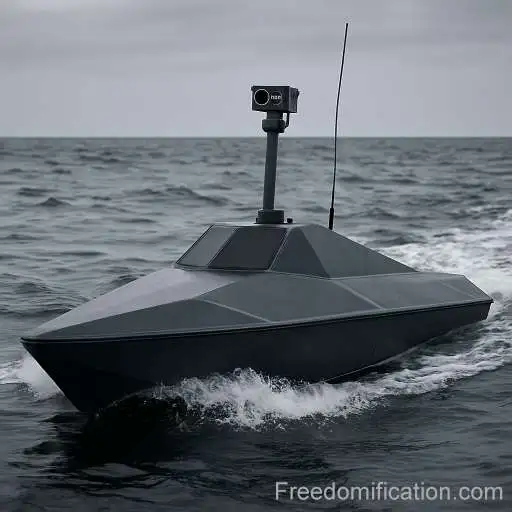
4. Naval Kamikaze Drones – The Nightmare of the Black Sea Fleet
This is a Ukrainian specialty that no one in the world had ever used on such a scale.
Unmanned naval vessels have:
- sunk or damaged over one-third of the Black Sea Fleet,
- forced Russia to relocate ships from Crimea,
- turned enemy-controlled waters into a risk zone,
- prevented Russia from fully blockading Ukrainian ports.
Navies around the world are watching in astonishment — a device costing tens of thousands can neutralize a vessel worth billions.
5. Networks and AI – The Real Innovation Behind the Scenes
Drones are only part of the story. Ukraine has built something even more significant:
A Networked Battlefield
- all units use unified coordination software,
- operators work on shared data platforms,
- AI helps track Russian movements,
- mapping systems operate in real time.
This is not “toys used by soldiers” — it is a connected ecosystem of reconnaissance, navigation, observation, and precision strikes.
6. Why Russia Is Far Behind
Despite its large resources, Russia lost the technological race for several reasons:
- its army is highly centralized, and innovation requires freedom,
- corruption paralyzes production,
- commanders are unable to adapt new solutions,
- Ukrainian FPV and AI systems evolve faster than Russia can react,
- Russian factories try to copy instead of invent.
The result?
Ukraine has built the world’s largest drone ecosystem, while Russia is still trying to catch up.
7. Global Reaction – The World Wants to Learn From Ukraine
Ukraine has become an exporter of military knowledge.
The United States, the United Kingdom, NATO countries, and even Asian states are analyzing:
- how Ukraine organizes drone operator networks,
- how it develops AI systems,
- how cheap technologies achieve high effectiveness,
- how production and training are decentralized.
Global military doctrines are shifting — and Ukraine stands at the forefront of this change.
8. What Comes Next? Forecasts and Future Directions
The coming years will bring:
- autonomous drone swarms,
- greater use of artificial intelligence,
- mini-drones for individual soldiers,
- stealth drones made from advanced composites,
- intelligent anti-drone systems (also Ukrainian),
- further long-range strikes against enemy infrastructure.
The war of the future will be:
cheap to produce, fast to adapt, AI-enhanced, and dominated by UAVs.
And Ukraine is already its pioneer.
Conclusion
Ukraine is not only defending its territory — it is creating a new era of modern warfare.
From FPV drones to naval kamikaze vessels, from improvisation to AI systems — all of this makes the world look at Ukraine not as a victim, but as a center of military technological revolution.
It is a topic not only timely, but fundamental to understanding modern conflict and global security.
Author: MJ