
Jangmadang: How Black Markets and Underground Capitalism Saved North Korea
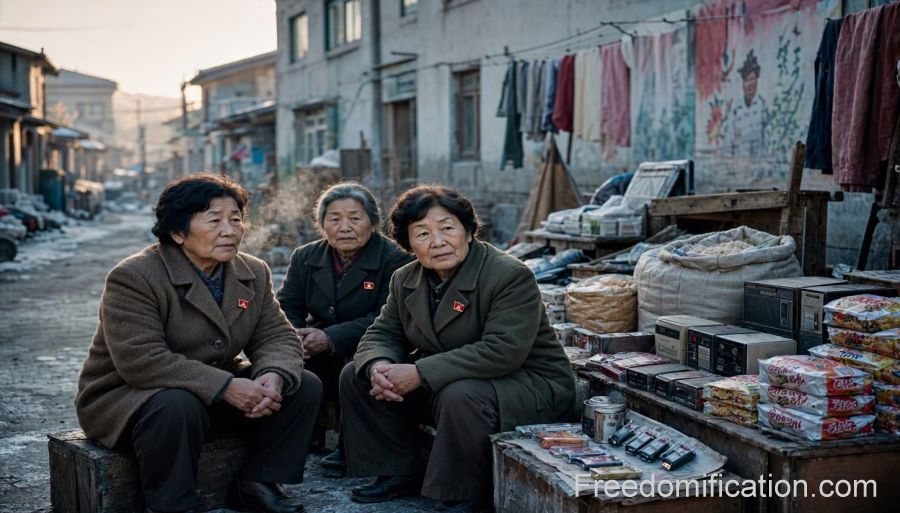
Officially, North Korea remains a socialist bastion where the state theoretically provides citizens with everything — from housing and medical care to food rations. In reality, the official Public Distribution System (PDS) collapsed during the tragic famine of the 1990s, known as the “Arduous March.” To avoid starvation, ordinary citizens took matters into their own hands, creating Jangmadang — informal, underground markets that evolved into full-fledged, illegal capitalism.
1. The Birth of Jangmadang: From Desperation to an Underground Economy
The term Jangmadang literally translates to “marketplace.” During the 1990s, when state factories ceased operations and rice distributions stopped, citizens began selling whatever possessions they had on improvised street corners: furniture, copper wires stripped from factories, homemade food, or clothing. Over time, simple barter trade transformed into a sophisticated supply network.
Why Is the Black Market Run by Women?
In the North Korean system, every adult male is legally obligated to report to a state-assigned workplace or factory — even if the factory has not functioned or paid wages for years. Failing to appear at work risks assignment to a labor re-education camp.
However, married women are exempt from this requirement and registered as housewives. Consequently, they became the primary breadwinners and architects of informal capitalism. Women run the market stalls, negotiate prices, and risk arrest while their husbands fulfill empty state attendance duties.
2. What Can You Buy at Jangmadang? Medicine, Jeans, and Foreign Culture
Today’s Jangmadang markets (often located in side alleys, abandoned halls, or open-air areas) offer almost everything unavailable in state stores:
- Food and Staples: Chinese rice, flour, cooking oil, pork, spices, and Chinese instant noodles.
- Medicine and Hygiene: The state healthcare system lacks basic pharmaceuticals. Smuggled Chinese antibiotics, painkillers, and IV fluids are purchased at the market.
- Clothing and Cosmetics: Chinese counterfeit clothing and sought-after South Korean cosmetics with removed labels.
- Technology and Media (“Under the Counter”): Portable Notel media players, smartphones, and USB drives or micro-SD cards containing South Korean dramas, Hollywood movies, and K-pop music.
3. Hard Currency and the “Donju”: Shadow Capitalists of North Korea
The national currency — the North Korean won — lost all public trust following a botched currency reform in 2009. Merchants on the Jangmadang markets routinely refuse local banknotes.
What Currency Is Used?
- Chinese Yuan (RMB): The dominant currency in border regions and most markets nationwide.
- US Dollar (USD): Preferred for high-value transactions (equipment, housing, wholesale trade) and within Pyongyang.
Who Are the “Donju” (Lords of Money)?
The expansion of the black market fueled the rise of a new social class known as the Donju (literally “money owners”). These private entrepreneurs and investors amassed wealth through wholesale trade, transport, and smuggling. Because private business ownership remains illegal, the Donju forge alliances with state officials — registering their private cafes, truck fleets, or tailoring workshops as “state enterprises” in exchange for profit-sharing with directors and security agencies.
4. The Smuggling River: How Goods Enter North Korea
The vast majority of goods reach Jangmadang markets across the border with China along the Yalu (Amnok) and Tumen rivers. The trade relies on bribery of border guards on both sides. Beyond physical merchandise, Chinese mobile network signals bleed across the border — residents near the frontier use smuggled Chinese phones to secretly communicate with defectors in South Korea and arrange money transfers.
5. Regime Relations: Toleration, Bribes, and Recent Crackdowns
The regime in Pyongyang maintains a complex stance toward Jangmadang. On one hand, authorities recognize that completely shutting down the markets would spark widespread famine and unrest. On the other, the black market erodes state dependence and introduces external information into society.
Corruption and Bribes
Officers from the State Security Department (Bowibu) and the police derive substantial income from market activity. Instead of closing stalls, they collect stall fees and bribes to overlook banned goods. Corruption serves as the lubricant allowing the shadow economy to operate.
Recent Crackdowns Under Kim Jong Un
In recent years, particularly following border closures during the pandemic, Kim Jong Un’s administration has attempted to reclaim central economic control. The state introduced stricter regulations against private trade, increased penalties for holding foreign currency, and passed the Anti-Reactionary Thought and Culture Act, imposing severe penalties — including capital punishment — for distributing foreign media from the black market.
Conclusion: A Quiet Social Revolution
Jangmadang represents more than food stalls. It is the birthplace of the “Jangmadang Generation” — citizens who hold no memory of relying on state hand-outs. While the regime attempts to restore total monopoly, shadow capitalism has permanently reshaped North Korean society, demonstrating that the drive for survival outweighs ideological doctrine.
➡️ Recommended reading:
Daily Life in North Korea: Between Routine, Absurdity, and the Struggle for Survival
Author: MJ