
From the 6:00 AM Siren to Evening Self-Criticism: A Day in the Life of a North Korean Citizen
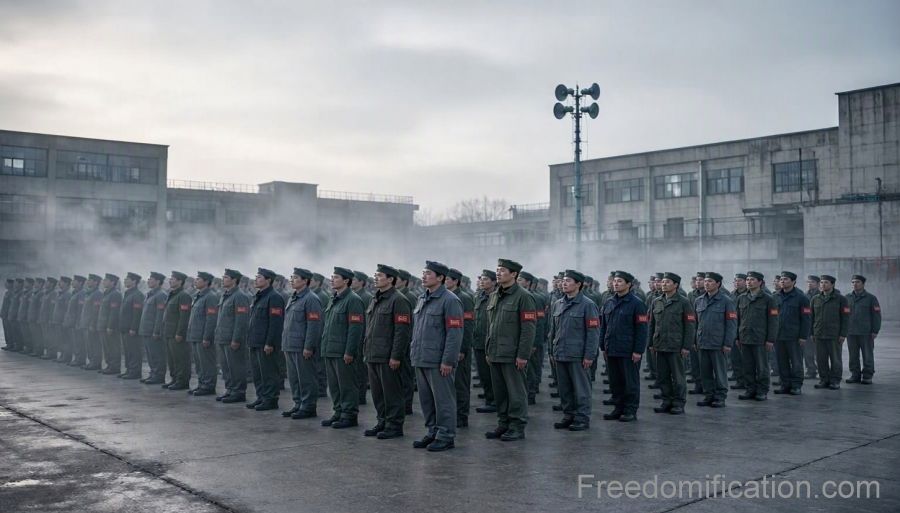
Life in North Korea is entirely dictated by the rhythm imposed by the state. For an average resident of Pyongyang or a provincial town, the day does not begin with personal plans, but with propaganda loudspeakers and mandatory loyalty rituals. Let us trace step-by-step what a typical day looks like for a citizen under a totalitarian regime — from the morning wake-up call to the secret life behind closed doors.
1. Morning and the Commute to Work (05:30 – 07:30)
State Wake-Up Call at 6:00 AM
In Pyongyang and major urban centers, the day begins with the sound of sirens or city loudspeakers. Promptly at 6:00 AM, by order of the authorities, a melancholic and haunting song titled “Where Are You, Dear General?” is broadcast, reminding everyone of the presence and “care” of the Supreme Leader.
Street Surveillance (Gyuyuuldae)
After a quick and usually modest breakfast, citizens head to work. Since public transport is often inefficient and overcrowded, most people walk or ride bicycles. At intersections and neighborhood entrances, inspection teams (Gyuyuuldae) made up of youth or women’s guards stand patrol. They check:
- Leader Lapel Pins (Kim-badge): Every citizen upon reaching adulthood must wear a pin featuring the portrait of Kim Il-sung or Kim Jong-il exclusively on the left side — close to the heart.
- Personal Appearance: Haircuts (which must conform to state-approved styles), the absence of blue jeans, and overall outfit appropriateness are strictly verified.
2. Morning Assembly at Work or School (07:30 – 08:30)
Before official work duties begin in factories, offices, and schools, a mandatory ideological briefing takes place.
Step-by-Step Assembly Procedure:
- Formation and Roll Call: Workers or students line up in orderly rows in the courtyard or factory hall. The local party cell leader strictly verifies attendance.
- Bowing to the Portraits: The entire group performs a deep, slow bow before the portraits of Kim Il-sung and Kim Jong-il hanging on the wall.
- Revolutionary Songs: Everyone collectively sings praise hymns honoring the Workers’ Party of Korea and Kim Jong-un.
- Newspaper Reading (Dokbo): Passages from the editorial of the official state newspaper, Rodong Sinmun, are read aloud. This sets the ideological tone and political narrative for the day.
- Production Goal Assignment: Only after the ideological section does the manager transition to economic matters — setting daily production targets, scrap collection quotas, or cleanup duties.
3. Workday and Afternoon (08:30 – 17:00 / 18:00)
Work in North Korean workplaces rarely takes place in silence. Propaganda broadcasts, revolutionary songs, and motivational speeches play continuously through facility loudspeakers. In many workplaces, due to chronic shortages of electricity and raw materials, production quotas are often replaced by manual physical labor or site maintenance.
4. Anatomy of Self-Criticism: Senghwal Chonghwa (Life Under the Microscope)
The most psychologically taxing part of the week in North Korea is the mandatory self-criticism session — Senghwal Chonghwa.
Frequency and Organization:
- Weekly (Saturday): Held every Saturday afternoon in small control groups (party cell, youth league, women’s union, or work team).
- Monthly and Annual: More extensive sessions summarizing long-term political and ideological standing.
Two-Step Session Scenario:
- Step 1: Self-Criticism (Confession of Fault): Each participant must stand up, cite a state principle or thought of the leader, and confess to a personal shortcoming. Minor and safe faults are chosen — for example: “This week, I did not study Comrade Kim Jong-un’s teachings with sufficient enthusiasm because I succumbed to physical fatigue.” Confessing to a serious political offense would result in being sent to a labor camp.
- Step 2: Mutual Criticism (Accusing a Peer): After confessing their own flaw, the individual is obligated to publicly accuse another group member. For example: “I observed that Comrade Pak was 5 minutes late for the morning assembly, showing a lack of respect for work discipline.”
Psychological Impact:
This mechanism effectively destroys social trust. It forces even close friends and neighbors to surveil one another, preventing any form of organized resistance or deep trust without the fear of being reported.
5. Evening, Public Mobilizations, and Secret Free Time (18:00 – 22:00)
Post-Work Mass Mobilizations
The official end of the workday does not bring freedom. Citizens are routinely drafted into “mass mobilizations” — unpaid community labor. Depending on the season, these include collecting scrap paper and metal, sweeping streets, infrastructure construction, or collecting natural fertilizer.
Unannounced Night Raids by Inminban
Upon returning home and eating a modest dinner, residents must prepare for unannounced visits from the head of the Inminban (neighborhood unit). The Inminban leader has the authority to enter any home at any time to inspect whether:
- unregistered overnight guests from other towns are present (without an official travel permit),
- the leader portraits are kept free of dust,
- anyone is using illegal radio or television receivers.
Life in the Shadows: Banned Foreign Media
Despite severe penalties under the Anti-Reactionary Thought and Culture Act, many North Koreans seek an escape from regime reality during the late evening. Citizens with small Chinese solar panels charge portable media players (Notel) or smartphones. Under blankets, with tightly covered windows and headphones on, they secretly watch smuggled South Korean dramas, variety shows, and listen to K-pop music from SD cards and USB drives.
Conclusion: A System of Total Time Capture
Daily life in North Korea is engineered so that citizens have no time for free, independent thought. From the 6:00 AM wake-up siren to late-night home inspections, every hour is filled with ideology, forced labor, or surveillance. It is this absolute control over human time and psychology that has allowed the regime to endure for decades.
➡️ Recommended reading:
Daily Life in North Korea: Between Routine, Absurdity, and the Struggle for Survival
Author: MJ